

OK, OKX
Let's go shopping


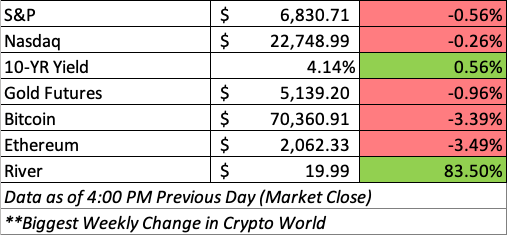
Good Morning & Happy Friday. U.S. stocks closed lower on Thursday as renewed conflict in the Middle East and rising oil prices weighed on investor sentiment. Markets remained focused on escalating attacks involving a U.S.-Israel coalition and Iran, which have spread across the region and entered a sixth day. Rising energy prices are raising fears that inflation could increase and complicate interest-rate decisions by the Federal Reserve.
Investors are also watching for Friday’s U.S. jobs report for clues about the labor market, while earnings from companies including Costco and Marvell Technology are helping round out the current earnings season.
Two shifts toward automation and institutionalization are emerging: Intercontinental Exchange’s investment valuing OKX at $25B highlights Wall Street’s deeper move into crypto infrastructure, while Google’s Universal Commerce Protocol points to a future where AI assistants handle everyday shopping on our behalf.” And don’t forget the BIR portfolio update.
Crypto News You Can’t Miss: Okay, OkX

OKX, one of the world’s largest cryptocurrency exchanges, has been valued at $25 billion after receiving a minority investment from Intercontinental Exchange (ICE), the parent company of the New York Stock Exchange. The deal highlights how major Wall Street institutions are increasingly investing in digital-asset infrastructure as cryptocurrency becomes more integrated into mainstream finance. As part of the partnership, ICE will license OKX’s spot crypto price data and launch U.S.-regulated crypto futures contracts, while OKX will distribute ICE’s U.S. futures and tokenized equities markets to its more than 120 million global users. ICE will also gain a seat on OKX’s board.
The valuation places OKX ahead of other recent crypto market entrants such as Bullish and Gemini. The investment follows ICE’s recent stake in Polymarket, the world’s largest prediction market, and comes amid broader signs that the crypto industry may be approaching a turning point after a prolonged downturn. Analysts say momentum could be supported by potential U.S. regulatory clarity, including support from Donald Trump for the proposed Clarity Act. At the same time, other industry developments—such as Kraken’s banking unit gaining limited access to the Federal Reserve payment system—signal increasing integration between digital assets and the traditional financial system.
Can We Automate Our Shopping?

I have never particularly enjoyed shopping. Some people genuinely like comparing products, browsing endless pages of options, and hunting for the perfect deal. For me, the experience usually feels like another administrative task that sits somewhere between paying bills and renewing a passport. It is something that needs to be done, but rarely something I look forward to.
This is why a new idea gaining traction in the technology world called agentic commerce caught my attention. In simple terms, agentic commerce means using AI assistants to handle many of the tasks involved in buying things. Instead of spending time searching websites, comparing prices, and navigating checkout pages, you ask an AI assistant to do the work and then approve the result.
Recently Google introduced something called the Universal Commerce Protocol, or UCP. While the name sounds technical, the concept behind it is quite straightforward. It is an open system designed to allow AI assistants to communicate directly with retailers. Instead of every store building separate integrations for each AI tool, UCP creates a shared language that allows AI systems to browse products, compare prices, and place orders across many retailers.
The goal is to make it easier for AI assistants to handle the entire shopping process from start to finish. For people who enjoy shopping, this might not sound revolutionary. But for those of us who see shopping as a time consuming chore, it could make daily life noticeably easier.
Take a very simple example. Suppose you need a new pair of running shoes. Today the process typically involves opening several websites, comparing prices, reading reviews, checking delivery times, and deciding whether the current price is fair. Even for a basic purchase, it can take twenty minutes or more.
With an AI assistant connected to systems like Google’s Universal Commerce Protocol, the process could look very different. You might simply tell your assistant: find a well reviewed pair of running shoes under $120 that can arrive this week. The AI checks multiple retailers, filters options based on your preferences, and presents one or two recommendations. You approve the purchase, and the order is placed. What used to be a small research project becomes a quick decision.
The same approach becomes even more useful with everyday household items. Many of us repeatedly buy the same things: cleaning supplies, printer cartridges, coffee filters, or replacement batteries. An AI assistant could track your purchasing patterns and reorder items when they are about to run out. At the same time, it could monitor prices and wait for discounts before completing the purchase.
Instead of realizing at the last minute that the printer is out of ink, the system quietly manages the process in the background.
Subscriptions are another area where agentic commerce could save both time and money. Many people accumulate a surprising number of recurring charges. Streaming services, software subscriptions, fitness apps, and digital publications can add up quickly. An AI assistant could monitor these subscriptions and periodically ask a simple question: are you still using this service? If the answer is no, the assistant cancels it. If the price suddenly increases, it alerts you before the next renewal.
Travel planning offers another practical example. Booking flights, hotels, and rental cars can require hours of comparison. An AI assistant could track travel prices continuously. You simply provide your travel dates, budget, and preferred airlines. The system searches options and books when prices look favorable. If a better flight becomes available later, it can alert you or adjust the reservation.
Even larger purchases could benefit. If you are considering buying a new laptop or television, the AI assistant could monitor prices across several retailers for weeks. When the price drops below a level you are comfortable with, it prepares the purchase and asks for your approval.
Of course, most people will not want to give an AI unlimited access to their bank accounts. These systems will likely operate with clear safeguards. The assistant searches, compares, and prepares the purchase, but you confirm the final transaction. The real benefit is not that the AI replaces your decisions. It replaces the time spent gathering information.
For retailers, systems like Google’s Universal Commerce Protocol could also change how products are sold online. Instead of relying mainly on flashy advertisements or carefully designed websites, stores will increasingly compete on things that AI assistants evaluate easily: price, delivery speed, reliability, and customer satisfaction.
For consumers like me, however, the biggest advantage is much simpler. Shopping becomes something that happens quietly in the background rather than something that demands attention.
The internet once made it possible to buy almost anything from your laptop or phone. Agentic commerce may take the next step by allowing us to buy what we need without spending time shopping at all. For those of us who have never enjoyed the process, that is a future worth looking forward to.
BIR Portfolio
The BIR portfolio posted a modest gain this week, rising 2.3% overall, although performance across individual tokens was mixed.
Keep reading with a 7-day free trial
Subscribe to The Blockchain Income Report to keep reading this post and get 7 days of free access to the full post archives.